Market Your Practice: Getting Started

1. How do I market my physical therapy practice? How do I get started?
First of all, let’s tackle what marketing really is and isn’t:
| What Marketing Is | What Marketing Isn’t |
| ✓ How you strategically attract more new patients to your practice | X Branding X A waste of money X Advertising X Running around town with a megaphone, telling people you opened a clinic |
To put it simply, marketing is a plan that you put into action to get more new patients.
Marketing should not be confused with advertising, which is the act of paying to put your . Examples would be running a radio ad, Facebook Ad, or Google search ad. Your overall marketing plan may include advertising! But advertising is a subset of marketing. It goes under it. If you jump right to advertising, you’re getting ahead of yourself. It’s like buying an engagement ring before you even start dating someone!
Marketing also shouldn’t be mixed up with branding. Your practice’s “brand” is how people talk about you when you’re not there. Like advertising, branding is a subset of marketing. Having a strong brand is important – but for most practices, it’s more fruitful to start with the question “How do I get more new patients?”, rather than “How do I build my brand?”. Building a solid brand will follow as you take action to get more people in your clinic!
Finally, marketing is not a waste of money. It’s an investment–which means, by definition, that you should get more money out of marketing than you put in! If you’re spending more money on marketing than you see results for, you’re either…
- Wasting money on a marketing system that doesn’t work
- Not measuring the results of your marketing properly (we’ll get to measuring marketing results later!)
But how do you get started with marketing?
We recommend you create a simple, effective plan.

How to Create a Marketing Plan for Your Physical Therapy Practice in 17 Minutes or Less

Creating a “marketing plan” can feel overwhelming. After all, you probably didn’t go to business school or get a degree in marketing.
Relax. Remember: other PT owners have done this already. That means you can too! Here’s how you can create a marketing plan for your physical therapy practice in 17 minutes or less. Set the timer for each of these sections, and let’s get started together!
- Consider your audience (2 minutes). Remember: when you’re marketing, you’re reaching out to potential patients. These patients did not go to PT school! They just want to know that you can help them get out of pain. Picture your most common patient in your head (Example: a 55-year-old woman with back problems). Write down what that patient is like, how they talk, what they care about, etc. Make sure all of your marketing will appeal to this person! Writing down what this person is like is sometimes called creating a “buyer persona.”
- Write down 1-3 practice goals (5 minutes). You probably have some idea of how many patients you need each week to keep your clinic full and pay your staff and rent. Or maybe you’ve hired a new PT and need to increase your number of patients to fill their schedule. Here are some great example goals:
- Get 10 extra new patients every week
- Diversify where I get patients from – get less than 50% of patients from doctor referrals
- Branch out into a new discipline (massage therapy, chiropractic, women’s health) and get new patients in that discipline
- Be able to predict my number of new patients every month
Do any of these resonate? Then copy them down! Remember, you’re not the first person to fill their clinic with patients. Lots of PT Owners are succeeding – and we’ll help you be like them.
- Figure out the general things you need to do to make those goals happen (5 minutes). This is the “strategy” part of your plan. A “strategy” is really just a set of coordinated actions you plan to take to reach your goal. Here are some examples:
| Your Goal | Your Strategy |
| Get 10 extra new patients every week. | Reach out to my list of past patients to see if they or their friends / family need more help. |
| Diversify where I get patients from – get less than 50% of patients from doctor referrals. | Start marketing my practice direct-to-consumer. |
Now go write yours down!
Do you know what your goal is…but don’t know what kind of strategy will help you reach it?
- Download the Ultimate PT Marketing Funnel – a proven, effective strategy that has helped hundreds of practice owners take their practice Direct-to-Consumer
- Keep reading this blog!
- Schedule a free 20-minute marketing consultation with a PT Marketing Expert. They’ll help you figure out your goals and guide you to your next step.
- Make a list of things you’re going to take action on this week, this month, and this quarter (5 minutes).
A plan is useless if you don’t take action on it! Write down specific steps for yourself that you’ll do this week, this month, and this quarter. Some of those steps might be “figure out who can help me get my practice website ranking higher on Google” or even “talk to a practice owner to see how they do their marketing.” It’s important that these action steps are SMART.
- Specific. Don’t just say “get more new patients.” Say “get 10 more new patients every week.” That way you know if you’ve achieved your goal or not!
- Measurable. If you just say “more” new patients, you’ll never know if you met your goal! Give yourself a target number. At least you’ll know if you hit it or not.
- Attainable. If you have a marketing budget of $100 / month, that may not be enough to reach your new patient goals. (Later in the blog, we’ll discuss budgeting, so stay tuned!)
- Realistic. If it’s just you doing your marketing, it’s probably not realistic to say you’ll learn Search Engine Optimization (SEO) and rocket your site to the top of Google all by yourself. You’re a human being. You can’t treat 40 hours a week and also do marketing 20 hours a week. Consider hiring a marketing expert instead.
- Time-Bound. Make sure you set a specific time range for you to take each of these actions. For example, “Hit 40 new patients / month by this September” is far better than just “get more new patients.”
Let’s go back to our sample physical therapy goals and strategies. Here are some actions that would be appropriate for each of them, in the this week, this month, next 3 month categories:
| Your Goal | Your Strategy | Your Actions |
| Get 10 extra new patients every week. | Reach out to my list of past patients to see if they or their friends / family need more help. | This Week: Send 2 emails this week to my past patients, letting them know we have a new PT who is a specialist in knee injuries.
This Month: Write, print, and send a printed newsletter to all past patients, offering a free health screening. Next 3 Months: Commit to sending a newsletter every month. Measure the number of patients who come back into the clinic and calculate your return on investment! |
| Diversify where I get patients from – get less than 50% of patients from doctor referrals. | Start marketing my practice direct-to-consumer. | This Week: Schedule 1 hour this week to make sure my clinic’s name, hours, and address are updated on Google My Business, Yelp, the Yellow Pages, Facebook, etc.
This Month: Google “physical therapy” in your city /state and see where my practice’s name shows up in comparison to competitors. Talk to one person who knows how to improve SEO & Google presence for a small business. Next 3 Months: Hire an SEO expert / marketing service to start writing blogs and improving the writing on your website to get you ranking higher on Google. |
And there you go! You’ve written out a physical therapy marketing plan! Now go take action on the things you said you’d do this week. Remember, you can do this!

2. How do I market to patients?
Do you have inconsistent patient volume?
The only way to fix inconsistent patient volume is with consistent patient marketing. That means reaching out to patients directly, wherever they are, and providing information that is…
- Helpful
- Empathetic
- Shows authority
- States clearly how you can help them with your pain
Remember Your Audience
The #1 thing to remember about marketing to patients is this: patients are patients. They aren’t physical therapists! That means that when you communicate with them…
- Don’t use jargon or technical medical language
- Don’t assume they know what PT is
- Show compassion and care
- Understand that PT and dealing with insurance can be scary
For example, instead of writing on your website: “We Are the #1 Treatment Center for Lumbar Radiculopathy,” it would be better to say “We Help You Get Relief from Back Pain Naturally.”
And you already know that! You know your patients. You talk to them everyday. So don’t put all that compassion and knowledge to the side when you start marketing. Focusing on patient marketing doesn’t mean you become a pushy car salesman! That’s not you. And that’s not what your patients like.
To learn more about how to write great copy (words) in your marketing, visit this blog: How to Write Good Copy for Your Physical Therapy Website • Practice Promotions.
But now that you know how to communicate with patients…how do you reach out to patients where they are? How do you get their contact information? How do you take people on a journey from not knowing your practice exists to committing to a plan of care?

A Simple 5-Step Process to Attract More New, Committed Patients
The Ultimate Practice Marketing Funnel has worked for the past 10+ years to help 1400+ practice owners revolutionize their patient marketing. The Funnel will help you take your practice Direct-to-Consumer ASAP. To download a simple PDF version of this to print out and paste on your wall, click here.
Remember: when it comes to patient marketing, you don’t have to reinvent the wheel! Follow this simple, effective process that has worked for other PTs, and you’ll be well on your way to being a marketing champion!
1. Attract patients online.
What do you do when you need an answer to something?
You Google it, of course!
Thousands of people in your community are doing the same.
But they aren’t Googling your practice name! Right now, they don’t know you exist. They might not even know that physical therapy exists. Instead, people are searching for things like…
- Help for back pain near me
- How to recover after an ACL injury
- Best physical therapists in [your city]
- Help with dizziness for senior
You want your practice name to show up on the first page of Google as the solution to each of these problems. That way, people find the solution to their problems on your website or blog, click on the link they see on Google, and visit your website! Now they know you exist– and know something about their problem.
It’s important to dominate the first page of Google, as well as Google Maps. Here are some statistics to show you why…
- 86.19% of desktop searches take place on Google. (Smart Insights)
- More than 87% of people perform a search engine query to find out about a business.
- 50% of clicks happen on the first three organic (not paid) results on Google. (Smart Insights)
Being on page 2 of Google means that almost no one will see your practice’s name.
But how do you get to dominate the first page of Google?
Here are a few actions that have proved HIGHLY successful for thousands of PT Owners:
- Get cracking on improving your Search Engine Optimization (SEO).
“Search Engine Optimization” means making your website appear trustworthy, organized, and authoritative to search engines like Google. Google is all about ranking the most useful content highest (at least in theory), so if your site is highly trustworthy, Google will rank your website higher on search results –without you paying anything! That means you’ll get seen by thousands more people searching for a solution to their pain online.
A lot of things go into improving your SEO, and we’ll get into that in the “How do I do digital marketing?” section of this blog. But at a basic level, the more useful information your website includes, the higher it will rank on Google. Your website should use important keywords and key phrases like “physical therapy”, as well as the specific conditions you treat, throughout your site.
That’s why we recommend all practice owners have a blog that they update 1-2 times a month, focusing on how physical therapy can help with different kinds of injuries. SEO is also why we don’t create just one “What We Treat” webpage for our clients; instead, we build multiple condition pages for each specific condition. That means a page for sciatica, a page for shoulder pain, etc. Creating lots of content-rich pages is both helpful for website visitors looking for a solution AND helpful for Google to rank your page well! It’s a win-win.
When it comes to SEO, you should consider hiring a marketing staff person or an outside marketing service. There are plenty of things in patient marketing that you can do yourself–but SEO isn’t one of them.
- Update your local search listings.
Make sure your practice’s name, hours, address, phone number, etc appear on local listings like Google My Business, Yelp, Yellowpages, Whitepages, and any other local listings. This will show your practice is reputable and lend more “domain authority” to your website. That means your site is more trustworthy and will rank higher on Google.
- Run Google Ads for “physical therapy.”
SEO can get you far! But these days, you have to pay to play if you want to dominate the first page of Google in multiple places.
PT-specific Google Ads will get your practice seen by thousands more people in your community. We recommend search ads, which only appear when someone is searching for a keyword you care about like “physical therapy.”

We also recommend Pay-Per-Click (PPC) ads, which make sure you only pay when someone actually clicks on your ad and visits your site. It’s a surprising, cost-effective way to drive more traffic to your website. And it’s one that thousands of PT owners are already using.
I know all this talk about ads can feel overwhelming. But this is a strategy that is already helping people win. You can leverage it too!
Plus, running Google Ads will boost your SEO results. When your practice name appears in multiple places on the first page of Google, your practice will appear to be more trustworthy. (And that’s good! You are trustworthy!) When someone sees a Google Ad, that actually increases the likelihood that they’ll scroll down and click on your first organic (non-paid) search result, which will send them to your blog / website.

For more specific information on Google Ads, check out this blog on 5 Reasons Your Physical Therapy Practice Should Advertise With Google Ads PPC.
- Run Google Ads for conditions.
Surprise! Most people don’t know that physical therapy is the solution to their problems! All they know is that their back hurts and they just want it to stop. They are far more likely to search “back pain help” vs “physical therapy clinics near me.”
So, if you’re running Google Ads, make sure you’re running ads for the conditions you treat!
Remember, when it comes to improving your SEO and running Google Ads, you may want to consider hiring an outside expert. Google changes frequently, and it’s important to keep on top of those changes.
Building your online presence is a must for practices that want to grow. It’s natural to feel overwhelmed by all the technical aspects of dominating Google.
But again: you’re not alone! Lots of PT, OT, and Rehab private practice owners are succeeding online. We’ve helped 1400+ skyrocket to the top of Google, and you can too.
Now that we’ve attracted people to your practice website, let’s turn to Step #2 in the Ultimate PT Marketing Funnel: building trust.
2. Build trust.
It’s not enough that people know your practice exists. They need to trust that you understand their pain, can help them, and have helped other people get out of pain in the past! Here are some actions you can take to build trust in your practice.
- Grow your number of frequent, 5-star Google Reviews.
Before you go to a new restaurant, do you read Google reviews? Of course you do! Potential patients are doing the same thing!

In our 20+ years helping PTs market their practices, we’ve found that it’s crucial that you have frequent 4 or 5-star reviews from patients on Google. Here are five tips to getting GREAT Google reviews for your clinic:
- Stop feeling awkward! We get it. You’re a PT. You don’t want to draw attention to yourself. But here’s the thing: patients don’t mind when you ask for a Google review! For the patient, it’s a chance to celebrate the progress they’ve made. So stop feeling awkward and ask for the review. In fact, make asking for a review part of how your clinic does business.
- Ask for a review at the right time. It’s important to choose the right time to ask for a review! We recommend you ask for a Google review a few weeks into your patients’ plan of care, once they start seeing results. After a breakthrough moment, when your patient is excited and happy, take the time to say: “Maggie, I’m really pleased with your progress. You’ve put in the work and I’m really enjoying helping you. Could I ask for your help with something? I’m always looking to help more people get better. It would be a big help to me if you left a Google Review. Just scan this QR code…” If your patients are icing, that is also a great time to ask for a review. They can do it right there as they finish icing!
- Ask specific questions. Some patients don’t know what kind of review to leave. But what’s more powerful: a review that says “Raj and his team were nice” or a review that says “Five months ago I struggled with vertigo and could barely get myself out of bed in the morning. Now, with Raj and the team’s help, I’m able to perform my daily tasks and drive myself to therapy. I’m even taking my grandchildren to an amusement park on Saturday, something I used to enjoy a lot. Now I can do it again! Thank you, Raj!” Ask your patients to describe the pain they felt before therapy and compare it to their level of movement, activity, or comfort that they feel now!

- Make it easy for your patient to leave a review. Don’t just say “leave me a review.” Make it easy for them when you…
- Put a “Leave a Review” button on your website’s homepage that links directly to Google or to reputation management software.
- Give them a review generation rack card with a QR code to scan that takes them right to Google! (Like these rack cards).
- Text or email them a link on the spot.
- Provide specific instructions on how to leave a review!
- Use reputation management software. It’s really hard when someone leaves a bad review. Sometimes it just takes one bad apple to make your online presence look terrible! To avoid this, use reputation management software! When a person leaves a 3-star review or below through this software, they’ll be guided away from posting the review on Google and encouraged to talk to you about their experience. But if they leave a 4 or 5-star review, they’ll be prompted to copy + paste their review on Google, Facebook, and Yelp! All Practice Promotions clients get reputation management software as part of their digital marketing services.
- Make getting reviews a staff game / competition. Have fun with review generation! Train your staff on how to ask for reviews, then kickstart a competition. If the team collectively gets a certain number of reviews…it’s pizza party time!
- Don’t forget about Facebook and Yelp Reviews!
Don’t forget about Facebook and Yelp reviews! When you ask for reviews, guide them to Google reviews first– but then ask people to copy + paste their reviews on Facebook and Yelp as well. Be sure to provide links to your Facebook / Yelp profiles so your patients don’t have to go search for how to do this.
- Wow patients with your website.
Another way to build trust with people online is by wowing people with your professional, beautiful PT website!
Getting physical therapy can be scary. Lots of people might get nervous at the idea of being touched by a stranger. So make sure people realize you’re not some weirdo in a dark room– you’re a licensed medical provider with a professional online and in-person experience.

Make sure your website is up-to-date, has a clean, modern look, and clearly states what you do and how you help people. Check out 6 Of The Best Physical Therapy Websites for Private Practices.
- Collect customer testimonials and put them on your website.
Remember how you asked for Google reviews? Ask your patients if you can use their testimonials on your website! Then, don’t just put testimonials on one page of your website. Sprinkle the testimonials throughout your site!
By showing you’ve helped other people get better, you build trust with future patients who are browsing your website. No one wants to take a risk with their health. Show people that you are great at helping people get their lives back. Because you are!
If possible, include a picture of your patient, or even a simple iPhone video of them sharing their story. Through our own testing, we’ve found that testimonial quotes that include a picture of the speaker perform much better than a quote without a face.
- Create a consistent brand presence.
Don’t have five different logos floating around! If you have a different logo or color scheme on your Facebook page vs Instagram vs your website, that looks unprofessional. So make sure your visual look is consistent.
Also make sure the words you use are consistent. Do you have a fun, casual tone? Then use that across platforms? Or is your approach more formal? That’s okay too – just make sure people experience the same tone across all your marketing.
3. Convert website visitors to patients.
Let’s say 1000 potential patients visit your website every month.
What good is that to you if none of them actually schedule an appointment?
Once patients land on your website, you need to capture their attention within seconds and get them to book an appointment. That’s the whole point of your website: to get you more new patients!
When a web visitor calls your clinic or fills out a “Request Appointment” form, that’s called a “conversion.”

Here are 5 features that every high-converting practice website has:
- A great homepage. Your homepage should clearly state what you do and present a vision of success for a patient! Headlines like “We help you get out of pain” or “Get back to your life with physiotherapy” are very successful.
- Request appointment buttons. Put “request appointment” buttons on the top right hand corner of your screen and in the center of your screen. Make sure they are in a bright color to draw attention. Make it easy for someone to request an appointment!
- A PT chatbot. Including an automated PT chatbot is a surprisingly effective way to rake in a few more patient appointments. You can even have the chatbot use your name / photograph!
- Lots of patient testimonials. Put patient testimonials everywhere! Proving that you’ve helped people get out pain in the past is pure gold and will get scared website visitors to finally take the plunge and book an appointment.
- FAQs. Remember, lots of patients don’t know anything about physiotherapy! Create an FAQ page to answer questions about insurance, what to expect, and even things like “Will physical therapy hurt?” Then remind your patient to book an appointment.
Right now, your practice website is probably converting about 1% of visitors into patients (or less!) So out of every 1000 visitors, maybe 10 give you a call.
But what if you increase your website conversion rate to 3%? Or even 5%? Now, instead of 10 calls, you’re getting 50 calls – without spending extra money on advertising!
Having a bomb website can skyrocket you from 10 calls / month to 50 calls /month without costing an extra cent.
How do I find out my practice’s website conversion rate?
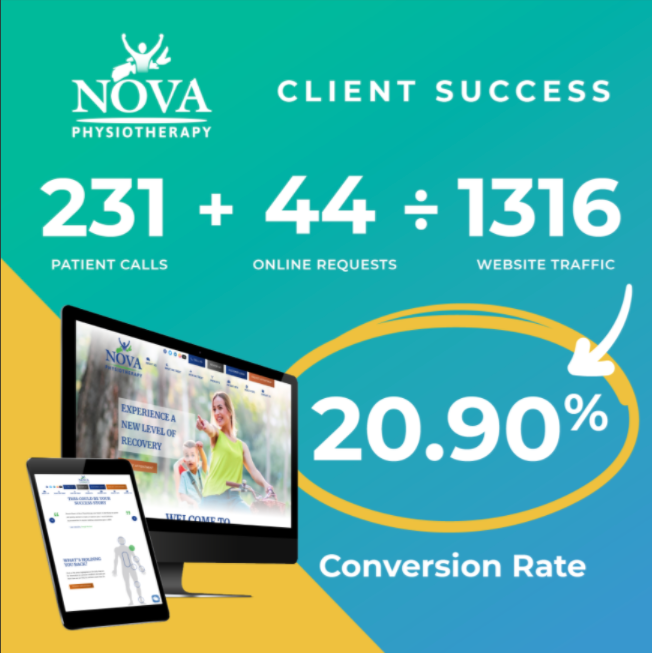
You can find this percentage by combining New Patient Leads from each source available on your website (Filled out appointment request forms, phone calls from your website, visitors who schedule via a chatbot, etc.) and divide that number by your Unique Website Visitors during the same span of time (The result will probably look like 0.019352672, which means about 1.9%).
What percentage of my website visitors should become patients?
Most experts agree a healthy range is about 1.5% – 5% range for most industries, but for practice websites anywhere from 1.5% – 3% is healthy. But what if your website converted up to 5% of its visitors? For the following clinic, that conversion rate was a reality!
4. Engage patients in their plan of care.
Are patients not completing their plan of care? That’s the worst! You know patients need to come back in for treatment, but too often patients ghost you and don’t finish their treatment. And that means they aren’t getting better the way you want them too.
Most practice owners don’t realize that you need to market to current patients, too! Patient marketing doesn’t end once someone commits to a plan of care!
So here are some ways to make sure that new patients don’t just come in once or twice– they come in for as long as it takes to get better.
- Make sure new patients feel welcome!
It’s crucial to get off on the right foot when patients come in for care. We recommend handing each new patient a New Patient Welcome Folder, complete with brochures on your clinic and your method of care. This will make your clinic look super professional, and your patient is bound to show their New Patient Welcome Folder to their friends or family when they get home. Check out examples of New Patient Welcome Folders here.

You should also create a New Patient Welcome email series to seal the deal. This will get your patient used to communicating with you through email – which will be useful even after they complete their plan of care. We made a quick guide on how to set up this email series, which you can download here: Email Marketing Cheat Sheet for PTs.
- Send patients health tips through email once a week.
Once the New Patient Welcome Email series is finished (it’s about six emails), continue to send patients health tips through email at least once a week. You can pull these health tips from your blog.
Make sure that these tips are actually useful. The point is to engage your patients, not bore them to death!
- Make doing at-home exercises easy with your own custom-branded mobile app.
If you’ve been a physiotherapist for any length of time, you know the immortal truth: the patients who get better the fastest are the ones who do their at-home exercises.
But you also know that very few patients actually do their at-home exercises. Maybe they don’t remember how to do the exercises. Or maybe they need an extra reminder.
That’s why a lot of PTs are seeing success by leveraging a custom, branded Home Exercise Program App. Our friends at PT Wired can help you create your own HEP app with your clinic’s name and branding. That way, you can load the videos you want your patient to complete on the app, making it easy for even the most difficult patient to complete their at-home exercises!
- Engage your patients on social media.
Social media is a fun way to stay connecting with your patients during and after their plan of care. Remember to post fun, helpful information on the clinic. This will transform your relationship from just “physical therapist– patient” to really making your patient feel like they’ve entered a community!
Scroll down a bit to see our section on “What is social media marketing for my practice?”
5. Turn patients into raving fans who refer others.
What if every single patient you had replaced themselves by recommending 1-2 friends to your practice?
That’s free marketing! And chances are, if your patient has been diligent to come in, their friends will be the same way. It is far, far less expensive to get a past patient to come back in vs. attract an entirely new patient.

So how do you turn patients into raving fans who recommend others?
- Send monthly patient newsletters.
It may sound super old-school, but creating a monthly patient newsletter and mailing it to all your past patients is a proven, effective way to get past patients back in for care! In the US, 59% of people say they enjoy receiving postal mail from businesses they like, compared to only 43% of people who enjoy getting emails. Those numbers are even higher in Canada, where 66% of people enjoy getting direct mail, and only 55% enjoy getting emails.
Jessica may know you helped her with her back three years ago, but unless you stay in touch, she might not realize that you can also help her with her vertigo!
Sending patient newsletters is especially valuable if you’ve been in business for a long time, or if you’ve taken over the practice of someone who has a large patient list.
For every 1000 newsletters you send, you can expect 10-20 patients to come back in the clinic or refer someone. Would that help your clinic?
Practice Promotions helps hundreds of practices design, write, print, and mail patient newsletters to their past patients. You can check out our practice newsletter portfolio here.
- Reactivate past patients with email marketing.
If sending patient newsletters sounds like a lot, don’t worry! Get started with email marketing, which is probably free or very inexpensive.
You would be shocked by how effective sending emails to past patients can be! Email marketing keeps your practice on the top of your patients’ minds.
Send past patients helpful tips, coupons for free screenings, or a free trial of a cash-based service. As long as your emails are informative and entertaining, your patient will be glad to receive them. You can expect dozens of patients to come in for care when you just start emailing them! They can also easily forward your email to their friends.
At Practice Promotions, at least half of our new clients give us a call as a result of email marketing.
- Bolster patient referrals with stellar in-clinic materials.
Don’t let your patient go home empty-handed! Make it easy for patients to refer their friends by sending your patients home with a New Patient Welcome Folder, practice brochures, rack cards about their condition, and copies of your most recent patient newsletter. It will make your practice look extremely professional.
We recommend you check out winning designs at PTMarketingStore.com.
And there you have it! Marketing your practice Direct-to-Consumer doesn’t have to feel scary. There’s a lot you can get started on this week that will bring you more new patients.

3. How do I market to doctors?
In the past decade, physician referrals to physical therapy have declined 55%. That’s why physical therapists need to be marketing direct-to-consumer in today’s world.
So you don’t want to be reliant on doctor referrals. But you don’t want to ignore them, either!
When you market to doctors, remember: physicians are people too! Just like you inform and entertain your patients with your marketing, you should inform and entertain doctors.
Here are a few key tips to increasing your number of physician referrals:
- Don’t beg. Show your authority and educate physicians on the benefits of physical therapy.
You don’t want to beg for referrals. And guess what?
You don’t have to. It doesn’t feel good. It doesn’t even work. So this is me giving you permission not to beg for referrals from your local doctor.
Instead, collaborate with doctors and show your expertise on the human body! You know things about how the body works that your average doctor doesn’t. Consider offering workshops for the doctor’s staff on spinal manipulations, etc. The doctor will probably end up learning a lot too! You’ll incur goodwill and respect. You’ll also increase the likelihood of that doctor referring to you.
- Have a “Physician Referrals” page on your website.
Make it easy for a doctor to refer you! They might not know how to refer to a private practice– so explain how it works on a Physician Referrals page on your website.
- Have a dedicated phone number or extension for physicians.
Again, you want to make it easy for a physician to contact you. Consider creating a physician-specific phone number or extension, so your front desk knows when a call from a physician is coming in! Doctors are busy people too.
- Promote your services with physician marketing print materials.
Mary McMillan, the Mother of Physical Therapy, faced a tough challenge in the aftermath of World War I. She needed physicians to refer patients to her!
The only problem? Doctors didn’t know what physical therapy was!
Mary recalled having to “sell” her healing technique to the doctors and patients. She decided to make “a sort of calling card” for the doctors to use to direct their patients to her, so “she had some prescription forms printed up and took them around the hospitals…Mary told the doctors and nurses to fill out the forms as if they were prescribing the work she was doing, just like medicine.”
Although at first the doctors were skeptical (“as if she was a snake salesman selling secret potions”), Mary eventually won the respect of the physicians around her.
If you’re like most physical therapists, this story should sound familiar to you. Custom prescriptions pads are still a highly effective way to increase physician referrals!

Drawing from Mary’s example 100 years ago, here are some of our favorite physician marketing tools:
- Custom prescription pads.
Custom prescription pads can make it easy for doctors to refer patients to you! Practice Promotions has helped hundreds of physical therapists design and print custom branded prescription pads with your clinic’s name, logo, and contact information. Depending on the insurance laws in your state or province, getting an explicit doctor referral may also make it easier to treat your patient with a variety of methods.
- Postcards to physicians.
We often recommend sending postcards to your list of past patients – but postcards can rapidly increase your number of referrals from doctors! You can assemble a list of local doctors with just a little sleuthing on Google Maps.
In fact, Madden & Gilbert Physical Therapy in Pennsylvania saw a 5x increase in referrals after they sent postcards to local physicians!

- Customized physician letters.
Consider sending a letter to physicians! At Practice Promotions, we can help you design, write, print, and mail letters to doctors in your area. Best of all, each letter will be customized with the doctor’s name and practice name. It will look like you typed up a letter, put it in an envelope, and personally mailed to the doctor.
In the contents of the letter, you can explain in greater detail how you help patients get their lives back.
- Consider bringing on a staff person to network with doctors.
You are a human being with finite time. Consider hiring a staff member whose sole job is networking with doctors and increasing your number of physician referrals!
However, don’t make the mistake of this being the same person who does all your digital, print, and patient marketing. That is too big a job for one person.
Don’t want to hire a large marketing team? Consider hiring external experts to manage your online presence and handle your print marketing. That will free up your marketing staff to focus on events, relationship-building, and other marketing tasks. And, as a shameless plug, Practice Promotions is helping 1400+ clinics with their digital and print marketing. We’d love to get on the phone and talk about helping you too!
- Showcase patient success stories.
The #1 best way to increase physician referrals is to show doctors that you are a professional, reputable clinic owner with a track record of success. Use patient testimonials as proof that you help people get back to normal without surgeries, injections, or medications! Plus, include photos of the people you help! That puts a human face on the testimonial and will increase your credibility with physicians, bringing you more patient referrals.
4. How do I get more word-of-mouth referrals?
Increasing your word-of-mouth referrals is an awesome, free way to increase your number of new patients!
In fact, many physical therapy owners have built their entire business on word-of-mouth referrals, without doing any other kind of marketing. That won’t sustain your business forever, but it’s a solid foundation to build upon.

Here are 5 ways to get started growing your number of word-of-mouth referrals:
- Make sure your patients have an awesome experience in the clinic!
You should already be a pro at this! You probably started your clinic so that you could deliver exceptional care to your patients. But just as a reminder…
- Make sure your practice has a soothing ambiance and is handicap-accessible.
- Greet your patients with a smile.
- Listen to your patients’ concerns with sympathy.
- Refrain from using medical jargon; if you must use technical terms, be sure to explain them.
- After the first evaluation, tell your patient their next steps in their path to recovery.
- Set clear expectations, but be optimistic!
- Communicate with your patients over email, text reminders, patient newsletters, and more!
- Train ALL your staff on the right ways to interact with patients. Make sure you have a friendly, helpful person answering your phones.
- Make it easy to pay bills / file insurance claims.
- Send your patient home with a New Patient Welcome Folder to show their friends and family!
Bringing in a lot of word-of-mouth referrals starts with a great in-clinic experience!
- Ensure your patients complete their plan of care.
Patients who complete their plan of care are the ones who get fully better. That means they are the ones who have the best experience and are most likely to refer others!
So make sure that your patients officially complete their plan of care and eventually “graduate” from physiotherapy. Patients who drop off the map will probably not refer to you, because – to be frank– they concluded on their own that coming in for treatment wasn’t worth it.
We recommend email marketing and direct mail marketing to keep patients hooked and continuing their plan of care.
- Give your patients the tools to increase referrals.
Have you ever shown a friend or family member a brochure? I certainly have!
There’s something about being able to touch and feel a brochure or newsletter that makes a business feel more real. I’ve even pinned a letter about stress relief up on my wall – which means I think about the doctor who wrote the letter every day!
To increase referrals to your practice, we recommend sending your patients home with a clinic brochure or a condition-related rack card. You should also consider mailing monthly patient newsletters to your current and past patients. They are sure to show it to their friends and family. This will increase your referrals and your number of new patients every month!

- Ask your patients: “Who is one person you know who could also benefit from physical therapy?”
Skyrocketing your word of mouth referrals can be as simple as asking for a referral. When a patient is about to complete their plan of care, or if they’ve just had a breakthrough therapy session, ask them if they know a friend or family member who could also use help from physical therapy.
Frame this request as a desire to help more people get pain relief naturally– because that’s true! Ask for a specific name, and ask your patient to reach out to them this week.
When you literally just ask for a referral, you’ll see your word-of-mouth referrals and number of new patients explode! Sometimes it’s the simple tips that work the best. Make sure all your PTs and staff know to ask people for referrals, as well. This should be your clinic’s policy!
5. What is digital marketing? How do I get started?
Digital marketing is any kind of marketing that takes place online, in the digital world! Or, to put it another way: digital marketing is how you get patients from the internet to give you a call! Digital marketing includes…
- Your practice website
- Your SEO
- Appearing on local listings
- Google Ads
- Your blog
- Email marketing
- Text reminders
- Social media marketing
- Any other form of online advertising
Pretty broad, right? It’s basically any way that you promote your clinic that isn’t face-to-face or something you can touch.
Here are 5 simple steps to getting started with digital marketing that work with any budget!
1. Start collecting emails and building an email marketing funnel for free.
Cost: Free
The fastest, most effective way to kickstart digital marketing in your practice is to collect email addresses and set up an email marketing funnel. In fact, I made my past company $250,000 in under a year just by leveraging email marketing, on a budget of $600! This stuff works, friends!
How email marketing works is…
- Offer valuable information in exchange for an email address. For example, on your website you could offer a free eBook on 5 exercises to help alleviate shoulder pain. Someone could download this for free…but they’d have to give you their email.
- Send helpful followup emails to turn someone from a casual ebook downloader into someone who’s truly interested in how you can help them get better!
- After a few emails, ask this interested person to come in for a free evaluation.
- Once a potential customer is in front of you, just work your physical therapy magic and explain how PT help them relieve their pain!
We’ll dive into this more in our section on email marketing below, but our favorite email marketing expert is Donald Miller with Business Made Simple and Storybrand. Check out his books and online courses.
2. Update your Google My Business profile and other online listing directories for free.
Cost: Free
This is a free, no-brainer move that you should do this week. Google rewards businesses that look reputable online. So, in order to increase your ranking on Google (you want to be first!), make sure your practice’s name, location, days / times that you’re open, phone number, email address, and website address are consistent on all of these sites. This will build your online authority immensely!
Make sure you appear on these sites, at a minimum:
- Google My Business
- Yelp
- Rehab.com
- Whitepages
- Yellowpages
At Practice Promotions, our SEO experts work every month to make sure your practice’s information is updated on dozens of online listings directories. This lends authority to your practice website. You need to do the same!
3. Make simple, free changes to your website to convert more patients.
Cost: Free
We get it – updating your website can feel like a massive endeavor. But again, there are some free changes you can make that will increase your website conversion rate! These include…
- Make sure your homepage includes a phrase like “We help you get relief from pain without harmful surgeries, injections, or medications.”
- Add request appointment buttons in a bright color to your homepage – or at least a “Contact Us” form.
- Put your clinic’s REAL phone number on the homepage.
- Use language that your patient can understand on your website! No medical jargon.
- Include patient testimonials with pictures throughout your site.
At my past company, simply adding a “Contact Us” button in the top right corner of our website immediately increased our number of contact requests. And that was a change we made for free!
Just imagine. Instead of having 10 out of 1000 visitors turn into a patient (or even 0 / 1000), what if 30-50 visitors out of every 1000 called you? What kind of difference would that make in your practice!
It would increase your number of new patients for sure! And that, my friend, is patient-centered marketing done right.
4. Post on your practice blog at least once a month.
Cost: Free
Blogs are a great way to drive traffic to your website! Why?
Well, most people don’t search for “physical therapy” on Google. They search for things like “best stretches for back pain” or “help with neck injury.”
When you write blogs with thrilling titles “5 Post-Work Stretches to Alleviate Back Pain”, you’ll start to show up for condition-related searches. This will help your practice rank higher on Google in your area. Then you can also share your blogs over email, social media, etc, and drive even more people back to your website!
Blogs build your authority as an expert with patients. They also build your authority online and will boost your Google ranking! AND they are free!
Here are a few physical therapy blog topic suggestions to get you started:
- 5 Post-Work Stretches to Alleviate Back Pain
- Hip and Knee Pain Getting You Down? Physiotherapy Can Help!
- Ready to Improve Your Health? You Can Do So With These 7 Tips
- Helping Your Child With Special Needs Cope With Stress
- Why Physical Therapy Can Help You Avoid Surgery After a Sports Injury
- Which is Best for You: Weightlifting or Cardio? Here’s How to Tell!
Write out a roadmap and commit to writing and posting one blog a month. And remember: no medical jargon! Write in a way that your patients will understand!
5. Post frequently to your social media profiles.
Cost: Free
You should post at least once a week on Facebook, Instagram, Twitter, and LinkedIn. Posting on your social media proves that…
- You are alive and functional as a business. (This is not a given in the post-COVID world! There are a lot of ghost profiles out there!)
- You know how to help people get better.
- Ideally, you and your staff are fun, personable people!
- Patients come to you regularly and get better!
Don’t expect social media to bring in a massive inflow of new patients. However, it is a free, easy way to connect with current and past patients.

6. Consider a website revamp.
Cost: Varies. Starts at $33/ day.
There are a lot of ways you can improve your physiotherapy website for free. But to really elevate your online presence, consider a website revamp. Really, you need to update your website every 2-3 years just to stay current!
And it’s not just about looking pretty! Getting your website redesigned can also…
- Increase your site load speed. Everyone hates a site that takes forever to load!
- Make sure your site is mobile friendly! 61% of website visits in the United States come from a mobile device (Zippia). Don’t turn patients off by a clunky design on mobile.
- Make sure your site architecture (how your website is organized on the back end) is Google-friendly. This will increase your Google ranking!
Regularly redesigning your website is so important that at Practice Promotions, we redo our clients’ website for free every 2 years!
If you haven’t updated your website in over 3 years, it’s time. Take the plunge and start asking your fellow PT Owners which company they used to redesign their website. And again– we’d love to help! We’ve built and designed hundreds of physical therapy and physiotherapy websites in the past 10 years. We’d love to build one for you, too.
7. Invest in PT-specific Google Ads.
Cost: Varies. If bundled with a new website, starts at $75 / day.
What if you could get your practice name in front of thousands more people in your community who are searching for a solution to their pain?
PT-specific Google Ads will help you do just that! In fact, you can expect to get 10-15 extra new patient calls every month with Google Ads with a $1k investment. If your average patient value is $1000, that means you are spending $1k on Google to make $10,000 – $15,000 in revenue!
Why should I use Google Ads for my private practice?
- You’ll dominate the 1st page of Google in multiple places.
- Google Ads target people who are already looking for a solution.
- Google Ads are a cost-effective and fast way to get more appointments online.
- Google Ads are location-specific, which can help a new or underperforming clinic.
- It’s easy to track your results.

After getting a new PT website, the next thing that most of our PT Owners say they LOVE is getting Google Ads to drive traffic to their website.
Please note: Google Ads are effective, but they are complicated! You should seriously consider hiring an outside expert to run your Google Ads. We do not recommend that you DIY your Google Ads, even if you have marketing experience. Practice Promotions helps 100+ practice owners with their PT-specific Google Ads – both in the United States and Canada. Give us a call – we’d love to help you get more new patients with Google Ads!
6. What is email marketing? How do I get started?
Email marketing is the act of reaching out to patients or potential patients via email. If you think email is an outdated method of communication – you’re wrong! Email is an excellent way to nurture your relationship with future / past patients and get them to come in for a plan of care.
Should I be using email marketing in my practice?
100% YES! Here are a few reasons you should be using email marketing in your practice:
- Email marketing gets results. Emails generate an average of $36 for every dollar spent (Litmus) which is excellent news for you because email sending systems aren’t very expensive. This is probably why 64% of small businesses choose email marketing to reach their customers! (Campaign Monitor)
- Email marketing is simple. You might not know how to set up Google Ads, but I bet you do know how to send emails!
- Email marketing is inexpensive. Most email marketing software is relatively inexpensive– we’re talking less than $100 / month. Just make sure you don’t store patients’ conditions, birthdays, etc, in your email marketing software, since that would be a HIPAA violation. To take that weight off your mind, Practice Promotions provides HIPAA-compliant servers for all our clients.
- Email marketing is personal. Here’s a secret: if you get a lot of emails from Practice Promotions, and they all have your name and company name in them, guess what? I didn’t send those emails individually! Those are automated emails that pull in your first name from our database. When I write the emails, I write something like “Dear [First Name]”. This adds a personal touch that (I hope!) you appreciate! You can easily do the same for your patients in your email sending.
- People want to receive emails. According to Hubspot, 74% of Baby Boomers think email is the most personal channel of receiving communication from brands and businesses. This statistic is followed by 72% of Gen X, 64% of Millenials, and 60% of Gen Z’ers.
- Email marketing is easily automated. The secret to email marketing is: you don’t have to go in and send emails every day! In fact, you can set up email sequences in advance so that a patient gets a certain series of emails once they complete an action. For example, you could set up an email sequence that plays after someone downloads an ebook from your website!

How do I write a good marketing email?
Don’t worry! Even if you’re not a writer, you CAN write a marketing email that gets patients in the clinic. I guarantee it.
Every good marketing email has three simple components. Just follow along with these and you’ll be a pro!
- A killer subject line.
Did you know that 47% of email recipients open an email based on the subject line alone? (OptinMonster)
If you write a boring subject line, your patient won’t even open your email! So make sure your subject line is both personal and thought-provoking. Be sure to use your patient’s name in the subject line, using the personalization features in your email-sending software.
We find three kinds of subject lines to be the most effective:
- Ask a provoking question. For example, “Mary – what if you could reduce your back pain with these 3 stretches?”
- State an attention-grabbing fact. For example: “Did you know that 82% of seniors suffer from back pain unnecessarily? Don’t be one of them!”
- Offer helpful advice. For example, you could be sending out a free guide, and write the subject line: “[Free Download] 5 Post-Work Back Exercises to Reduce Pain”.
Don’t just talk about yourself in your subject line! Your subject line should speak to your patients.
- Fun and informative body.
In order to keep your patients’ attention, you have to either be fun and informative– and ideally both! Also, ask yourself: what do you want to achieve with this email? Do you want people to read your blog and build a relationship with you? Do you want them to come back in for care?
Don’t just send emails because everyone else seems to be doing it. Each email should have a clear purpose, whether it’s nurturing a relationship, increasing your referrals, or getting a patient to come back in for care.
Make it easy for your patient to answer the question: what does this PT want from me right now?
- Call to action.
The #1 mistake that people make is not calling people to action in their emails! People want to be told what their next step should be! Some good calls to action are:
- Schedule your free evaluation today!
- Click here to register for our Shoulder Pain Workshop
- Read our blog
- Download this eBook
- Schedule your next appointment ASAP
- Leave a Google Review by clicking here
“Learn more” is a weak call to action. Learn more about what? Be specific! If you want someone to take an action (leave a review, schedule a PT evaluation), you need to tell them to do so!
Otherwise, people will read your emails and leave thinking, “That was nice, but I’m not sure why my PT sent me this.”

4 Automated Email Sequences You Need in Your Practice
Automated email sequences are a game changer. “Automated” emails means you don’t need to sit down at your desk every day and send mass emails – these email sequences are just triggered when a patient takes a certain action! It’s like an invisible email marketer working around the clock just for you!
And the best part is: it’s not difficult to set up! Almost every email-sending software allows for automated campaigns. Here are 4 automated campaigns that will bring patients flowing into your practice:
- Lead generation email sequence.
A fantastic, free way to capture peoples’ email addresses from your website is by offering a free checklist or ebook. Basically, you provide valuable information in exchange for their email address! Their email address is valuable to you because now you can contact them.
Then, after someone downloads your eBook or PDF, send them followup emails with even more useful tips. You are now in the “dating” stage of your relationship. They agreed to go on a first date with you when they downloaded your PDF. Now continue to build the relationship!
Through your automated emails, try to get them to take the next step towards coming in for care – like scheduling a free movement evaluation or attending a workshop in person. This will build the relationship with your future patient before you even meet them!
Plus, we made it easy for you to get started! You can download a free lead generation email sequence here.
- New patient welcome series
Once your patient comes in for their first appointment, you want them to be dedicated to their plan of care! We suggest sending a New Patient Welcome Series to get patients not only committed to coming in, but excited about it!
When patients don’t complete their plan of care, you lose money. You don’t want to go to all this effort to attract a new patient–only for them to only come in once or twice! Plus, you know that people won’t really get better if they don’t come in.
So, solidify your relationship with your new patient by sending them a series of welcome emails. Download a quick guide to doing just that here.

- Past patient nurture series
After a patient completes their plan of care, you still want them to remember you! You should email past patients useful information 2-3 times a month, so that you stay at the top of their minds. This is called a “nurture” campaign. Even if your patients don’t open your emails, they’ll still see your name in their inbox, and they are more likely to refer their friends to you.
A great way to do this is simply emailing your past patients a digital edition of your monthly newsletter, in addition to mailing it to them.
- Bring past patients back in the clinic
Mrs. Robinson knows that you did wonders for her neck pain last year…but does she know that you can also help her husband with his sciatica?
We recommend sending “sales” or patient reactivation emails to your past patient list at least once every few months. This isn’t slimy or salesy–it’s genuinely helpful! Often, patients don’t make the connection between how you helped them three years ago and the new problem they are facing now.
So offer another free evaluation or checkup! Remind your patients that pain isn’t normal. Otherwise, Mr. Robinson might spend months in unnecessary pain while his sciatica gets worse, not realizing that physical therapy is the answer.
The goal of this automated sequence should be: get past patients back in the clinic for care! What if 50% of the appointments on your PTs’ schedules were from reactivated patients or family referrals? Would that help your practice grow?
Email marketing is a fantastic, effective way to get started with marketing your practice. Reach out to us for advice on how to get started! At Practice Promotions, we offer a HIPAA-compliant email sending solution, as well as dozens of beautiful email templates that make it easy for your or your marketing staff to send emails to patients.

7. What is social media marketing? How do I get started?
Social media is all the rage these days – but it’s important to know that social media by itself is not a marketing strategy! The non-sexy things like SEO and website design will do far more that social media marketing to get you more new patients.
But that doesn’t mean you shouldn’t engage on social media! Follow along to kickstart your social media presence in a way that delights, informs, and entertains your followers.
What channels should I be posting on?
When you consider which platforms you should post on, the #1 thing to consider is your audience. Where does your ideal patient spend their time on social media? Figuring this out can be as simple as asking your patients. For example, middle-aged patients are more likely to be on Facebook than TikTok. Here are a few top channels:
Despite the rise of Instagram, Twitter, and TikTok, Facebook is still the king of social media. 69% of American adults have a Facebook account, and 75% of Facebook users visit a local business’s page at least once a week (Omnicore). Make sure you create a Facebook business page for your practice and keep the location, hours, and name updated. Share events, workshops, and photos of your clinic on Facebook.
If you provide membership services in your clinic, consider making a private Facebook group that’s exclusive to members where you share extra health tips.
Another major player on social media is Instagram! In 2022, 37% of American adults were on Instagram. It’s also the fastest-growing social media platform in Canada! (Quantum Marketer)
Instagram is a great place to put pictures of your clinic, health and stretch tips, and other visual information. With just your smartphone, you can also take videos of stretches or treatments, easily edit them within Instagram, and share them as Stories! Instagram really makes it easy to share attractive visual content and build a following!
Twitter allows you to send short 240-character posts online! In 2022, 23% of American adults use Twitter (Omnicore). And of people who use Twitter, 46% of users log on to Twitter every day. Twitter is a great way to reshare other content, like from your blog or YouTube channel, or give short updates on what your clinic is up to!
YouTube
Want to share your expertise? Consider starting a YouTube channel where you demonstrate your physical therapy techniques for free! PTs who started in the early 2000s have built up tens of thousands of views on their channel – but don’t worry. It’s not too late to start.
Google privileges video content on search engines, so having a thriving YouTube channel is a great way to get your clinic on page 1 of Google in multiple places.
Again, it doesn’t have to be fancy – an iPhone or smartphone camera can take high-quality footage that you can post on YouTube! Then, share your YouTube content over Facebook, Instagram, TikTok, and all your other social channels.
You can definitely connect with patients on LinkedIn – but LinkedIn is also a great place to make one on one connections with other professionals in the physiotherapy / rehab community. Join groups for PT Owners and see how they are marketing their practices – and don’t be afraid to reach out and individually message people! PTs generally love helping other PTs.
TikTok
Do you have a good sense of fun? Do you treat a lot of student athletes? Then TikTok may be the platform for you! TikTok is a video platform owned by Chinese company Bytedance. It also has the highest engagement rate of any social media platform (Influencer Marketing Hub), so if you’re active on TikTok, your followers will likely like and share your videos.
And TikTok isn’t just for the kids! In 2022, over half of TikTok’s American users were aged 18 -34 (Statista). If you have a younger patient base, and the time and humor, starting a TikTok profile may be a great way to connect with your patients!

What should I post?
Remember, the point of social media is engage patients with your content so they eventually become patients themselves or refer others! The goal of social media, like all marketing, is to get new patients. It’s not something you do for fun.
To engage patients, here are some good types of posts:
- News about your clinic – a new hire, a renovation, etc. Anything to show that you are thriving and growing!
- Patient testimonials with pictures
- Health or stretch tips (can be reshared from your blog)
- News about a workshop, free evaluation, or new service opening up
Here are things you should AVOID when you post:
- Religious or political posting
- Meaningless “feel-good” posts that don’t relate to your practice or your treatment philosophy
- Things that are too centered on yourself and how great you are. Remember, you need to be patient-centered in your marketing!
- Negative or profane posts
How often should I be posting?
There’s no magic rule to how often you should be posting! Some practices post every day.
A good rule of thumb is to post at least once a week. That proves that you are still alive and active. Don’t let months go by without posting, or else potential patients may think you’ve gone out of business!
Do I need to spend money on social media marketing?
Whether or not you spend money on social media marketing depends on your goals.
- Do you simply want to engage with people who already know and like you?
- Or do you want to get your practice in front of new people, who have never heard of you before?
If you want to get seen by new people, you will need to invest money in your social media marketing. Here are some options to consider:
What are organic posts?
This is when you post on social media for free. You don’t spend any money. However, bear in mind that your post will only be seen by a small percentage of your followers– on Facebook, it’s only 2%. The more likes and shares you get, the more people will see your posts!
What are boosted posts?
“Boosting” posts means paying Facebook to show your posts to more people. This will definitely get your posts more likes and shares! However, we do not recommend boosting posts.
Why? Well, when you boost a post, you can’t control exactly who it’s shown to. Facebook just gets you more likes and shares. If you’re going to put money behind social media marketing, we recommend you do so in a more controlled, targeted way: through Facebook / Instagram Ads.
What are Facebook / Instagram ads?
If you want your practices’ name to get in front of entirely new people in your community, running Facebook or Instagram ads may be a good solution. You will have to pay for these ads, and there is some setup required.
However, running ads allows for more targeting. For example, you can show a Facebook ad to everyone who visits your website!
We recommend that you don’t just run an ad that says “Schedule a Consultation.” Instead, run an ad that offers something valuable – like a free workshop or PDF on getting better from surgery – in exchange for their email. Facebook has native forms that allow people to fill out their information right on Facebook, without having to sign up on an external signup page. Then, put someone in an automated email sequence that turns them from a PDF downloader to a loyal patient who comes into the clinic for care.
Will social media marketing get me new patients?
It might! However, WAY too many PTs think that posting every day amounts to a “marketing strategy.” A better investment of your time and effort is on the foundational pieces of marketing: a solid online presence and a website that converts visitors into patients.
Don’t make the mistake of thinking that just because you have an Instagram account, you have a marketing strategy.
But also don’t make the mistake of discounting social media entirely! See it for what it is: just one of the tools in your marketing arsenal.

8. What is Google Ads PPC marketing? How do I get started?
Google Ads Pay-Per-Click (PPC) are ads you run on Google that make your practice website appear in the search results when someone in your area searches for something like “physical therapist near me.”
Google Ads are used by millions of websites and businesses across the world, and are a great way to drive more traffic to your website, increase patient appointments, and get ahead of the competition (Wordstream).
Every day, thousands of people in your community are searching Google for solutions to their pain. Google Ads PPC make sure that your practice name shows up in the search results for relevant searches! Again, ads skyrocket your clinic’s name to the TOP of Google for key phrases like “physical therapist in my city” or “back pain near me”.
That means people searching for a solution will find your clinic – FAST!
For example, one of our physiotherapy clinics added PT-specific Google Ads, and saw a 67% increase in new patient appointments in just 5 months! That’s pretty incredible.
Why should I use Google Ads?
- You’ll dominate the 1st page of Google in multiple places.
When you search “physical therapy near me”, hopefully your practice already shows up in the organic (unpaid) results! (And if you don’t…give us a call!) However, you’ll notice that organic results are below paid results on Google!
To appear on Google multiple times – both in a paid position and in an unpaid position – you need to be running ads! And when your practice name appears more times on the first page of Google, people are more likely to trust you and visit your website.
Just check out these sample search results:

Google Ads bolster your organic SEO– it’s not a replacement. Often, we find that when a practice runs Google Ads, potential patients see the ad and then scroll down and click on the practice’s organic result below it. But that’s okay! The Google Ad is still driving traffic to your website.
- Google Ads target people who are already looking for a solution.
Google advertising is the only advertising that targets people who are already looking for help!
Just think about it. If you run a radio ad, you’re blasting your message out to lots of people who don’t even need help. The same is true of Facebook ads – you don’t know for sure that these people are in pain!
But Google ads appear in front of people who are already looking for a solution on Google! This means your prospects are much more likely to visit your website and book an appointment.
- Google Ads are a cost-effective and fast way to get more appointments online.
A lot of people think that Google Ads are expensive. But that’s not true! A good cost per click is around $2-5. Would you pay someone $5 to sit down and read a brochure on your company? That’s basically what Google Ads PPC do– just for thousands of people every month! When you spend $1k / a month, you can expect to get around 10 extra new patients a month. If each patient is worth $1000 to you, that means you spend $1k to make $10,000!
That’s totally worth it.
Plus, you control your budget. If you can only spend $500 / month on Google Ads– that’s fine! You can set up your campaigns so that your ads will only spend $500 over the course of a month and then shut off.
Finally, Google Ads are fast! You can launch your ads in just a few weeks and be getting more new calls to your practice as soon as your ads are live. In contrast, direct mail takes time to write, design, print, and mail out to your patients.
- Google Ads are location-specific, which can help a new or underperforming clinic.
Google ads will only show up in the specific geographic area that you care about. Want to get super-targeted to drive patients to a new or underperforming clinic? That’s possible! Google Ads can be shown to specific zip codes.
Location targeting saves you money and makes sure you’re attracting qualified people to your practice website.
- It’s easy to track your results.
You can track your number of clicks and cost per click within Google itself!
At Practice Promotions, we use a software called WhatConverts to track your number of Google Ad “conversions”. Conversion refers to the number of people who “convert” from a Google ad by booking an appointment or calling you.
From beginning to end, you can trace your return on investment with Google and make sure Google Ads are making you 2-3 times what you’re spending.
What keywords should I rank for?
Remember, your potential patients probably aren’t searching for “physical therapy” online. Instead, they are searching for things like “help with back pain near me.”
Our Google Ads PPC specialists make sure that our customers rank for the following keywords:
- Physical therapy in [city, state]
- Your practice name
- Back pain
- Neck pain
- Shoulder pain
- Elbow pain
- Knee pain
- Any specialty your clinic has: pelvic health, speech therapy, aquatic therapy, etc

Can I run my Google Ads myself?
If you or someone you know has wasted money on Google Ads in the past, it’s probably because you tried to do it yourself.
Google Ads are hard! It’s easy to make mistakes and accidentally lose a LOT of money.
That’s why you need to trust a professional to do your Google Ads, like the friendly Google Ads Specialists at Practice Promotions. We do not recommend that anyone runs their own Google Ads, even if they have marketing experience.
Because when Google Ads are done right, they help you get seen by THOUSANDS more patients online. When Google Ads are done wrong, they can drain thousands of dollars from your practice.
Don’t do them wrong. Trust an expert.
How am I charged for Google Ads PPC? Do I pay Google directly?
Using Pay-Per-Clicks ads means you only pay when someone CLICKS your ad and visits your website! This is opposed to Pay-Per-Impression (PPM), where you are charged by the number of times your ad is shown. It is much more cost effective to only pay for clicks.
Again, we recommend that you get outside help with your Google Ads. At Practice Promotions, we charge a monthly fee to run your Google Ads; in addition, you pay Google directly for whatever you want to spend on ads. We don’t benefit at all from you paying Google more money!
Overall, Google Ads are a fantastic way to dominate page 1 of Google and drive thousands more people to your website every month. For just a $1000 monthly investment, you can expect to see 10-15 extra new patients every month.

9. What is direct mail marketing? How do I get started?
Direct mail marketing is reaching out to patients or doctors with physical, printed mail! In fact, the #1 way to get past patients back on your schedule is by sending direct mail: like patient newsletters, postcards, catalogs, or letters.
But isn’t direct mail dead?
No! In fact, 90% of direct mail ends up seen by recipients, compared to only 20-30% of emails. Plus, the response rate for direct mail is up to nine times higher than that of email. That’s crazy!
Finally, on average marketing mail is kept in the household for 17 days (CompareCamp). That’s 17 days of people looking at your practice name and wondering: “Could physical therapy help me? How about Grandma? Those spinal injections don’t seem to be helping.”
Isn’t printing and mailing…super expensive?
Again, no!
Direct mailing has a GREAT return on investment. This multi-location clinic used newsletters to reactivate 68 patients in 60 days. When you subtract the cost of printing and mailing…this clinic made $64,000 in profit…from just 2 newsletters!
Would you spend $2000 to make $64,000?
Plus, with call tracking, you can PROVE that direct mail is bringing people in. So…is direct mail dead? No! It’s actually a genius, cost-effective way to get past patients back in your clinic.
How do I use direct mail to market to patients?
We recommend you send direct mail every month to your list of current and past patients. Your list of past patients is a gold mine that not enough PTs use!
In the US, 59% of people say they enjoy receiving postal mail from businesses they like, compared to only 43% of people who enjoy getting emails. Those numbers are even higher in Canada, where 66% of people enjoy getting direct mail, and only 55% enjoy getting emails.
Direct mail also has a very high response rate – up to nine times higher than that of email.
So you definitely want to communicate with your patients in a way they enjoy!
However, we do not recommend that you send cold postcards or newsletters to random people in your area who don’t know you! Just think about it. Do you respond to cold postcards from your local lawn service or tree cutting company? Probably not.
So save yourself some money and only send direct mail to people who already know you.

Here are 3 kinds of direct mail you should consider sending:
- Patient newsletters.
Patient newsletters are a massively successful way to get past patients back in the clinic. Why?
Because it’s personal. It makes past patients still feel connected to your community.
Plus, it’s profitable. Our customer Preferred PT spent $3,240 to print and mail a patient newsletter to past patients. This reactivated 11 patients, leading to a PROFIT of $10,560.
What are the components of a great patient newsletter?
- Cover. Your cover should grab your patients’ attention and get them to open the newsletter! Don’t be afraid to have fun with this.
- Main article. In your main article, you should give helpful information about physical therapy, stretching, and / or health. Make sure that your topic is seasonally relevant. If fall sports are about to start, make that the topic of your August or September newsletter!
- Staff spotlight. Add a personal touch when you include information about your PTs and staff in your newsletter. Mention new hires, work anniversaries, or important life events here!
- Health tip / recipe. You’d be surprised by how many people will follow your health tip or recipe. They may even keep your newsletter around in their kitchen to follow the recipe.
- Call to action. Offer a free screening, coupon, or trial of a cash-pay service in your newsletter. Remember, the point of a newsletter is to get past patients to come back in the clinic for care!
- Mailing panel and contact information. You’ll need to leave a space to put your patient’s address and information. Also, be sure to include your clinic name, logo, address, and phone number on each piece of direct mail, so that it’s easy to contact you!

- Postcards.
After patient newsletters, postcards are our most successful ways to get past patients back on your physiotherapists’ schedules.
Here are some types of postcard campaigns you should consider:
- Opening a new clinic
- Moving locations
- End-of-Year Deductibles – encourage patients to come back in once they’ve met their insurance deductible. Their therapy might be free!
- New Year, New You postcards – take advantage of New Year’s Resolutions and encourage people to take control of their health by coming in for therapy!
- Letters.
You should also consider sending printed letters to past patients. This is especially effective if you have a major announcement that requires explanation: like if you’re adding a new service offering like women’s health. You can also send a letter on your patient’s birthday or to follow up 6 months after they complete their plan of care!
These letters can be personalized so that your patient’s first name is printed on the letter itself.
Ready to get started and send past patients flooding into your clinic? Order newsletters, postcards, letters, and more at PTMarketingStore.com.
How do I use direct mail to market to doctors?
Direct mail is extremely effective in marketing to past and current patients–but it can also be used to market to doctors!
We recommend sending brochures or letters to physicians. These direct mail products will educate local doctors on the benefits of physical therapy!
In fact, when our client Madden & Gilbert started sending brochures to physicians, they saw a 5x increase in doctor referrals over the next few months!
To get started, just assemble a list of local doctors in your area and their practice’s mailing address.

How do I use direct mail to hire?
Are you struggling to hire therapists and staff?
You can also use direct mail to create a pipeline of physical therapists who are eager to work for you! Our CEO, Neil Trickett, used this when he ran his physical therapy clinic in Florida. He sent patient newsletters and letters to local PTs – even PTs who were already employed – and got them to call in and get excited to work for his practice, even before Neil had open positions!
Then, when two of Neil’s PTs quit, he was able to call up the people who responded to his direct mail and immediately fill those slots!
All you need to get started is the mailing addresses of PTs in your area.
How do I get started with direct mail marketing?
There are a lot of components to sending direct mail, which is probably the reason many physiotherapists don’t use it. These steps include…
- Assembling your list of doctors or past patients, with their names and addresses
- Writing the content (words) on the newsletter
- Designing the newsletter / postcard so that it looks beautiful when printed. (This will require a graphic designer)
- Sending the design + lists to a printing service
- Paying for postage
- Shipping & mailing the item
It can be a labor-intensive process that requires, at a minimum, a graphic designer, a writer, and a project manager. That’s why we recommend getting outside help to make sure you create, print, and mail your newsletters on time every month – without overburdening yourself or your team.
But remember– direct mail works to bring in past patients! So don’t just write it off because it’s complicated.
Practice Promotions has helped thousands of PT owners like yourself design, print, and mail millions of patient newsletters and other direct mail, resulting in hundreds of new patients every year! In fact, Madden & Gilbert PT recently switched from Newsletter Pro to Practice Promotions for their newsletter services.
We’d love to help you, too! Visit PTMarketingStore.com to kickstart your custom quote.

10. How do I know if my marketing is working?
First, that’s the perfect question to ask. Whenever you are marketing your practice, you need to ask yourself: so what?
You gain 1000 Instagram followers. So what? Are they likely to become patients or refer others? If not, that’s a basically worthless number.
So how do you know if your marketing is working?
We recommend keeping track of these five statistics to have a gauge on the health of your practice marketing:
- Website Conversion Rate
Your website SHOULD bring new patients to your door. Is your site underperforming?
Example: if you have 1000 visitors to your website this week, but only 1 visitor downloads an eBook, subscribes to your blog, or requests an appointment, you have a 0.01% website visitor to lead conversion rate.
Why use this metric?
- Find out if your website is scaring new patients away
- Add more lead generation tools (chatbot, eBooks, PT blog) to to get patients to take action on your website
- Do you need to invest in a new practice website this year?

- Leads to Evaluation Conversion Rate
A lead is an individual who has demonstrated interest in your clinic. Includes chatbot leads, workshop attendees, eBooks downloads, submitted website appointment forms, or new patient call-ins.
Example: 50 Leads opt-in for a free ebook on your website
- 10 of those request free a consult/evaluation
- Your lead to evaluation conversion rate is 10/50, or 20%
Why use this metric?
- Find out if you are effectively calling patients to action
- Make sure your front desk is converting prospects
- The goal is to get evaluations
- # of Reactivated Patients
Your past patient list is a gold mine. Are you doing enough to market to past and current patients?
Example: First Choice PT consistently mailed 1000-1200 newsletters to past and current patients. This helped them increase their monthly reactivated patients from 1 to 29 in just 12 months!
Why use this metric?
- Far less expensive to reactivate a past patient vs. attract a new patient
- Reduce reliance on physician referrals
- Repeat customers build referral opportunities
- Track over years to measure practice growth
- With monthly newsletters, you can expect 0.5 – 1% of your past patients to be reactivated each month
- Example: If you want 10 past patients to return this month, you need to market to 1000 people
How to market to past patients:
- Provide useful content in patient newsletter
- Provide incentives to return for needed care
- Free consults for family and friends
- Calls/emails to check in
- Be patient! Results take up to a year to build up
- Leverage postcards, brochures, and rack cards to increase referrals

- Customer Acquisition Cost
Your Customer Acquisition Cost (CAC) can be calculated by simply dividing everything you spent on acquiring more customers (marketing expenses) by the number of customers acquired in the period the money was spent. Your Target: 20-25% of the lifetime value of the patient HINT: If your average reimbursement for a patient’s plan of care is $960, don’t spend more than $240 in CAC. Aim for $200.
Example:
- You spend $3000 per month on marketing salaries + expenses and generate 40 new patients.
- 3000/40 = $75 CAC
Why use this metric?
- Helps you focus on Marketing Return On Investment (ROI)
- Identify marketing efforts that aren’t working (market smart, not hard)
- Infers metrics and results (trends)

- % of Completed Plan of Care
If a high percent of your patients complete their plan of care, that leads to great PR and reputation. A low percentage of completed care means you have a bad reputation and will get fewer referrals.
Your Target: 90% Patients Completed Plan of Care
Example:
- Of 50 New Patients this month, 40 completed their plan of care.
- 40/50 = 80% POC Completion.
Why use this metric?
- Reveals gaps in your customer experience
- A main driver of profitability for the practice
- The most money you will ever lose is the money you never made
Finally, you should audit your patient marketing efforts every quarter. Compare the list of people who got emails or newsletters to the past patients who came in for care. What was your conversion rate for emails? Newsletters? If you’re running Google Ads, how many patients did those bring in?
Always make sure that you are spending less on marketing than you are making in revenue!